.png)
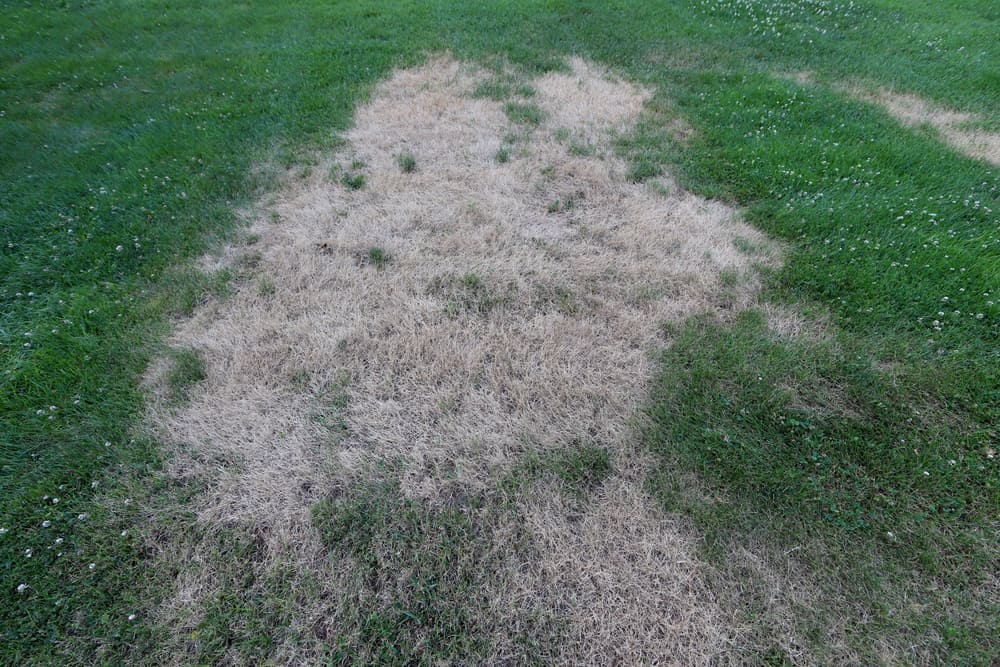
In late summer, Knoxville homeowners sometimes walk outside in the morning to find that an entire section of their lawn — healthy and green just days before — looks like it's been mowed down to the scalp. No drought. No disease. No obvious cause. By afternoon, the damage has spread another few feet.
That's fall armyworms at work. And the speed is not an exaggeration. A heavy armyworm infestation in peak feeding conditions can consume a lawn faster than most homeowners have ever seen any pest operate. The name is apt: they move in a wave, stripping everything in their path.
The good news is that armyworms are beatable — if you catch them early. The key word is early. By the time the damage looks severe, the window for effective treatment is already narrowing.
What Fall Armyworms Actually Are
Fall armyworms (Spodoptera frugiperda) are the larval stage of a moth. The moth migrates northward from the Gulf Coast each summer, arriving in Tennessee and surrounding states between July and October depending on conditions. Females lay eggs in masses — a single female can deposit 1,000 or more eggs — and the larvae hatch and begin feeding within a few days.
The caterpillars go through six developmental stages (instars) over 2–3 weeks. The first three instars do relatively little visible damage and are nearly impossible to spot. The final three instars — especially the last two — are the destructive phase, and this is when homeowners first notice the problem. By that point, the larvae are already large, voracious, and days away from pupating.
Time is the critical variable. Young larvae (1st–3rd instar) are easy to kill with a single application. Large larvae (5th–6th instar) require higher rates and may not be fully controlled before they finish feeding and drop into the soil to pupate. Acting on first symptoms, not visible devastation, is what determines the outcome.
How to Identify Armyworms
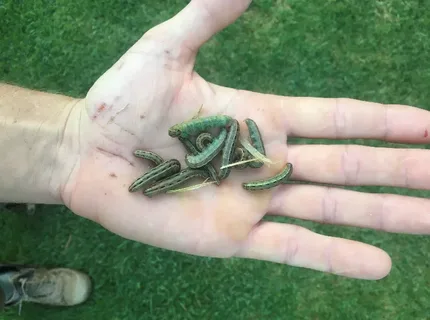
The larvae are caterpillars, typically 1–1.5 inches long at peak feeding size, with a distinctive appearance:
- Body color ranges from light tan to dark greenish-brown, often with a striped pattern along the sides
- A prominent inverted "Y" marking on the head capsule — the most reliable identifying feature
- Four pairs of small, dark spots along the back, arranged in a square pattern
You can find them by parting the turf at the edge of the damage and looking at the soil surface and the base of grass stems, especially in early morning or evening when they feed most actively. During the heat of the day they tend to retreat deeper into the thatch layer.
Signs of Armyworm Damage vs. Other Problems
| Characteristic | Armyworm Damage | What It Can Look Like Instead |
|---|---|---|
| Speed | Rapid — visible change in 24–48 hours | Drought stress or disease (slower progression) |
| Pattern | Ragged, uneven edges; moves directionally | Drought damage is more uniform per zone |
| Grass condition | Blades eaten or shredded, stems intact or removed | Fungal disease discolors but rarely removes blade tissue |
| Time of year | Late July through October in Knoxville | Chinch bugs: June–August; disease: variable |
| Birds | Heavy bird activity probing the turf is a strong indicator | Birds rarely forage intensely in drought or disease areas |
The Bird Test
One of the most reliable early warning signs of an armyworm infestation is unusual bird activity — specifically, large numbers of starlings, grackles, or robins probing and pecking intensely at one section of your lawn. Birds are extraordinarily good at finding armyworm larvae, and a flock working a concentrated area almost always means something worth investigating is just below the surface.
Knoxville Timing and Risk Periods
In East Tennessee, armyworm pressure typically builds in late July and peaks between August and early October. The severity varies significantly year to year based on how far north the migrating moth population travels and what conditions favor reproduction.
Years with warm, wet late summers tend to produce the worst outbreaks. Lawns adjacent to crop fields, open meadows, or properties with unmowed grass at the perimeter are at higher risk — armyworms move from dense vegetation outward into lawns, not the other way around.
Fescue lawns are highly susceptible. Bermuda and Zoysia are damaged too, but their faster growing rate means they typically recover more fully. Fescue that gets stripped in late summer may not have enough growing season left to recover before winter, making fall overseeding necessary.
Treatment: What Works and When
The most effective treatment window is early instar larvae — ideally before the damage is extensive enough to be obviously alarming. This is why monitoring matters so much.
What professionals use
Licensed applicators have access to several highly effective product classes for armyworm control, including spinosad-based biologicals (effective on young larvae with minimal non-target impact), pyrethroid insecticides (fast knockdown on larger larvae), and diamide insecticides (longer residual, effective across instars). Product selection depends on the size of larvae present, the extent of infestation, and proximity to water features or pollinator habitat.
DIY limitations
Consumer pyrethroid products are available and can provide some control on young larvae. The main limitations are: consumer formulations are lower concentration than professional products, coverage of the soil surface and thatch zone is harder to achieve without commercial equipment, and large larvae (5th–6th instar) are considerably harder to kill with any formulation. If you're seeing large caterpillars and substantial damage, a professional application is almost always the better investment.
Treat in the evening. Armyworms are most active and most exposed at dusk and during the night. Evening applications get better contact with active larvae and reduce UV breakdown of the product before it can work.
After the Infestation: Recovery
Once armyworms are controlled, the lawn's recovery depends entirely on timing and grass type:
- Bermuda and Zoysia can recover from armyworm defoliation relatively quickly if treated before mid-September, as they still have warm-season growing days ahead. Apply a light fertilization to support regrowth.
- Tall fescue damaged before October can often be overseeded into existing turf. Fescue stripped in October or later may not germinate and establish before cold weather — in that case, plan for early fall overseeding the following season.
- Heavily stripped areas on any grass type may need core aeration and overseeding to achieve full recovery, especially if the soil surface was exposed for more than a week.
Do not fertilize heavily immediately after an infestation on fescue — soft, lush growth going into winter is more susceptible to disease. A light balanced application or potassium-only application to support root hardening is the right call.
Prevention Going Forward
There's no reliable way to prevent moths from laying eggs in your lawn — they migrate in from hundreds of miles away and arrive on weather patterns you can't control. What you can control is how quickly you detect an infestation and how healthy your turf is going into the peak risk season.
- Monitor weekly from late July through October. Walk the lawn perimeter and check for bird activity, unusual discoloration, or ragged grass texture.
- Keep turf dense and healthy. Thin, stressed turf is more severely damaged and recovers more slowly. Regular fertilization and overseeding builds the density that makes your lawn more resilient.
- Mow at the right height. Fescue mowed at 3.5–4 inches going into late summer is more heat-tolerant and provides slightly less ideal conditions for armyworm egg-laying than a scalped lawn.
- Reduce perimeter vegetation. Tall grass and weeds along fences and property edges create a staging area for armyworm migration into lawns. Keep these areas managed through late summer.
Seeing Armyworm Activity in Your Lawn?
Don't wait until the damage is obvious. Our certified technicians respond within 24 hours and can assess the situation before a small problem becomes a full-scale infestation.
Request a Free Assessment